TRADITIONAL SICILIAN KNIFE FENCING SANTA MARIA STYLE
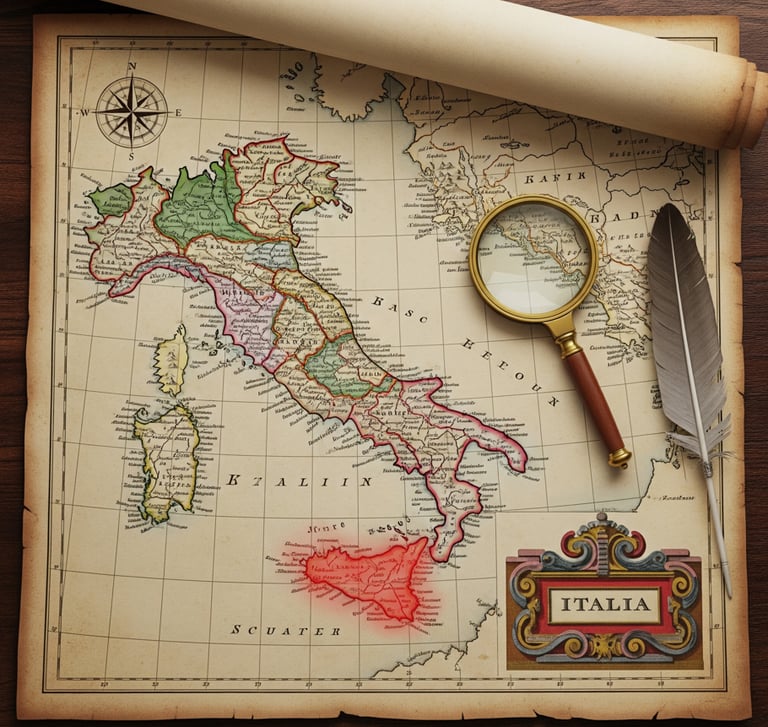
"Sicily is the one marked in red."
The Style of Santa Maria: The Sicilian Knife Art Between History and Honor
Italy has always had a deep-seated tradition in martial arts, particularly those involving the use of the knife and staff. These roots are firmly planted in a past where self-defense wasn't a choice, but a necessity for daily survival. After a long period of oblivion, these disciplines are fortunately being revived thanks to the dedication of enthusiasts who are keeping them alive across the country. This article, the first in a series dedicated to these extraordinary traditions, aims to shed light on Sicilian knife fighting, focusing specifically on the Style of Santa Maria.
Considered one of the most technical and complete styles, it is distinguished by the cunning, dignity, and effectiveness in self-defense, qualities that have marked the history of Sicily for centuries. Although the name "Style of Santa Maria" is quite recent, the art itself is lost in the mists of time, jealously guarded and passed down within worthy families. This system of transmission was a true self-defense mechanism: the fewer people who knew the techniques, the fewer chances there were for countermeasures to be developed. It was a matter of survival, a precious knowledge not to be shared outside of one's own family. In an era where disputes of honor and duels were a daily occurrence, this approach made deep sense.
In southern Italy, and particularly in Sicily and Calabria, the absence of a strong state had created fertile ground for banditry. It was precisely this lack of protection that led to the birth of the first "societies of honor," the only ones able to guarantee a semblance of justice and private security. In this context, schools of knife fencing flourished, where the masters' teachings were considered an invaluable asset to be preserved in anonymity.
Unlike the sword, which was a symbol of high social status, the knife was a tool accessible to everyone, used daily for various tasks. However, knowing how to wield it skillfully gave a reputation that was a primary value in that historical period. Training was often disguised, and it is here that we can find the roots of many folk dances in southern Italy—a way to practice without others noticing. This tool therefore had a dual identity, both civilian and for dueling, and duels to settle matters of honor, though extremely dangerous, were a common practice.
Today, this tradition has come down to us transformed into a sporting duel that maintains the philosophy of honor and humility. Beyond the martial aspect, the style educates practitioners in self-esteem, determination, and the ability to face everyday problems with the mental flexibility required in a duel. All of this translates into a deep personal growth and a greater well-being for the individual.
The fighting philosophy of the Style of Santa Maria is based on deception, cunning, and precision. The goal is not brute force, but masked strikes and movements that seem almost ritualistic, designed to confuse the opponent. While the other person tries to decipher those gestures, the decisive lunge arrives. Unlike other cultures, such as the Filipino one, Italian fencing prefers to strike with the point rather than the blade's edge. In the Style of Santa Maria, the point is aimed at vital areas and, in particular, at the opponent's armed arm. The use of a folding knife, rather than a fixed-blade one, allows for surprise attacks, thus placing a crucial emphasis on the first strike.
Unlike other disciplines, there is no centralized association dedicated to this style. For this reason, its teaching is entrusted to workshops, private lessons, and associations that are committed to keeping it alive and spreading it, ensuring that this fascinating art is not lost to time.