

Best Martial Arts Near You: How to Find the Right School in the US
Finding the best martial arts near you can be a game-changer, but with thousands of dojos across the United States, making the right choice is tougher than it looks. Whether you’re looking for MMA, Brazilian Jiu-Jitsu (BJJ), or self-defense classes, this guide will show you exactly how to vet a school like a pro.
Best Martial Arts Near You: 5 Red Flags of Scam Gyms (2026 Guide)
Searching for the best martial arts near you? Don't fall for "McDojo" traps. Learn how to spot real instructors, avoid predatory contracts, and find a reliable gym focused on your well-being and actual skill.
U.S.A.
Cubeddu G.Mario
1/20/20266 min read
Let’s get one thing straight: typing "best martial arts near you" into a phone is the start of a minefield. In the United States, martial arts is a massive business, and where there is big money, there is often big deception. You aren't just looking for a place to sweat; you’re looking for a sanctuary for your physical safety and mental growth.
But here’s the problem most modern dojos have traded their soul for a high-converting sales funnel. If you want a serious martial arts academy that actually teaches you how to move, fight, and stay healthy, you have to ignore the five-star Yelp reviews and look at the "hidden" signals of a reliable gym.
1. The "Biohazard" Audit: Hygiene is Expertise
You can’t have well-being in a petri dish. Martial arts involves high-intensity contact, which means skin infections like staph and ringworm are real risks.
The Mat Culture: Does the instructor stop class 10 minutes early to have everyone scrub the mats? If not, run. A trustworthy school treats its training surface like a surgical suite.
The Gear Smell Test: Walk past the heavy bags. If they smell like a wet dog, the ventilation is poor and the equipment is rotting from the inside. A high-performance facility invests in high-CFM air filtration and antimicrobial gear.
The First Aid Station: Check if they have a visible AED (Defibrillator) and a trauma kit. If they don't care about your heart stopping, they don't care about your long-term health.


[A high-end, clean martial arts facility with professional-grade wall pads and an instructor overseeing the post-class cleaning ritual.]
2. Instructors: The "Master" vs. The Business Manager
In the US, "Professor" or "Sensei" is often just a title bought with a franchise fee. To find the best martial arts education, you need to judge the instructor's behavior on the floor.
The "Phone-Watching" Plague: If your coach is leaning against a cage wall checking their texts while you’re drilling a double-leg takedown, they are stealing your money. A serious instructor is constantly moving, adjusting hips by half an inch, and explaining the leverage—not just the move.
The Ego-Driven Sparring: Watch the "Advanced" class. Is the instructor "smashing" the students just to show off? That’s a massive red flag. A real pro uses sparring as a teaching tool, adapting their intensity to the student's level to foster skill acquisition.
Technical Communication: Can they explain the biomechanics of a strike? If their only answer is "because that's how we do it," they lack the Expertise (E-E-A-T) you're paying for.
[A martial arts coach in a Gi, kneeling to adjust a student's grip with total focus, illustrating a hands-on teaching style.]


3. The Business Model: Spotting the "McDojo" Contracts
The American fitness business model loves "subscription traps." A greedy gym sees you as a monthly recurring revenue (MRR) stat, not a human being.
The "Belt-Testing" Scam: If there is a "mandatory" fee every time you get a new stripe or belt, you’re in a belt mill. These places dilute the art to keep you paying. A legit academy promotes you based on performance, and the belt usually costs $10 at most.
The Iron-Clad Membership Agreement: Be careful with predatory contracts. If they demand a 12-month non-cancelable commitment before you've even broken a sweat, they know their "product" is bad. A reliable gym offers month-to-month options because they know their value will keep you coming back.
Hidden Fees: Watch out for "Association Fees" or "Insurance Fees" that weren't in the initial quote. Transparency is the bedrock of Trustworthiness.
The "McDojo" (Profit-First) The Real Deal (Student-First)
Guaranteed Black Belt programs .No guarantees; you earn it through sweat
Sales reps in suits at the front desk. The head coach greets you at the door.
Hidden "Testing" and "Association" fees. One clear, all-inclusive monthly price.
No live sparring allowed for "safety." Controlled, supervised "live" rolling or sparring.
![An image of a clean, one-page gym membership agreement with no fine print, symbolizing business transparency.]
4. The 30-Second "Gut Check" for New Students
When you walk in, stop talking and start observing.
Look at the eyes of the students: Are they energized and focused, or do they look like they’re bored at a 9-to-5 job?
Check the wall of fame: Is it just photos of the owner, or is it a board showing the community's achievements?
The "Vibe" of the Mat: Is there a "tough guy" atmosphere where everyone is trying to "kill" each other, or is there a culture of mutual respect and safety?
If the place feels like a high-pressure car dealership, walk out. Your search for the best martial arts near you should end in a school, not a sales office.
![A diverse group of martial arts students of all ages bowing to the instructor, showing a culture of discipline and mutual respect.]
"If you want to understand what real, pressure-tested expertise looks like, you have to look at systems that evolved far away from the commercial 'belt mills' of the suburban US. For instance, the Sicilian Short Knife (Scherma Corta Siciliana) is a masterclass in functional movement and historical combat efficiency. Understanding the deep-rooted history of the Paranza Corta gives you a clear benchmark for what a 'serious' martial art should look like: it’s not about flashy trophies, it's about a lineage of survival and technical precision that has survived for centuries."
"If your search for the best martial arts near you has left you wanting something deeper, more authentic, and rooted in centuries of real-world history, you need to look at the elegant yet deadly arts of Italian Knife Fencing. Unlike the commercialized systems often found in local strip malls, the native Italian schools offer a raw, sophisticated lineage of combat.
For those truly interested in the soul of European weaponry, I highly recommend exploring the technical depth of Sicilian Knife Fencing and the gritty, urban legacy of The Genoese Knife: Tradition and Survival in the Caruggi. These aren't just sports; they are survival systems born from the streets and the honor codes of Italy.
From the tip of Sicily to the port of Genoa, dozens of unique schools of knife and stick fencing exist, each with its own secret techniques and specialized footwork. If you are a practitioner or a historian looking for the 'real deal' beyond the mainstream, feel free to reach out to me directly at storiesofthedojo@yahoo.com.
Buona Vita a Tutti (Good Life to All)!"
FAQ: Finding the Best Martial Arts Near You Without Getting Scammed
Q: How can I tell if a martial arts school is just a "McDojo" profit-mill? A: Look at the belts. If you see 8-year-old "black belts" or if there’s a guaranteed timeline for promotion (e.g., "Black Belt in 2 years"), you’re in a McDojo. A serious academy promotes based on skill acquisition and "live" performance, not your ability to pay for the next testing fee. If the focus is on selling you gear rather than fixing your footwork, walk away.
![A close-up of a rack of belts in a martial arts school, but with a focus on a student sweating and working hard in the background, symbolizing merit over purchase.]
Q: Is it normal for a gym to demand a 12-month contract immediately? A: In the American fitness industry, it’s common, but it’s a red flag. The best martial arts schools offer a trial period or a month-to-month "introductory" rate. If they try to "hard close" you into a long-term membership agreement before you’ve even stepped on the mat, they are prioritizing profit margins over your well-being. A confident gym knows you'll stay because of the quality, not a legal trap.
![A clean, transparent pricing board in a gym lobby with clear 'no-contract' options visible.]
Q: Should I worry if a martial arts gym doesn't allow sparring? A: Yes. While safety is the priority, "sparring" or "rolling" is the only way to test if the techniques actually work. If a gym claims their style is "too dangerous for sparring," they are usually hiding a lack of Expertise (E-E-A-T). A reliable facility will have supervised, controlled sparring sessions where safety gear (headgear, shin guards) is mandatory and egos are left at the door.
![A pair of high-quality MMA gloves and shin guards sitting on a clean mat, representing the balance between realistic training and safety.]
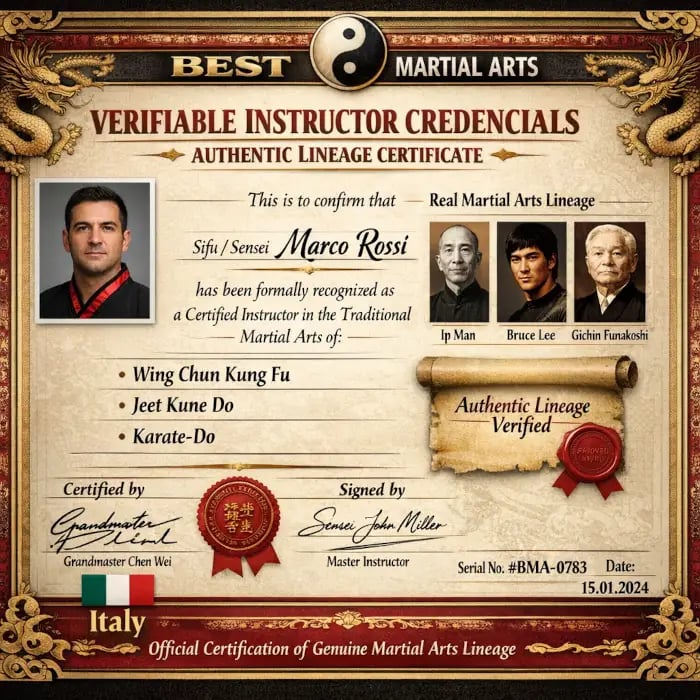
Q: What certifications should a "serious" instructor actually have? A: Titles like "Master" are unregulated. Look for verifiable credentials: black belt lineages you can track online (especially in BJJ or Judo), certifications from recognized bodies like the NCSA or NASM for strength work, or a verified professional fight record. A trustworthy instructor is transparent about their background and won't get offended if you ask who they trained under.
![An instructor showing a wall of certifications and a lineage chart that tracks their training history back to recognized masters.]
Join Our Journey
Explore the secrets of martial arts with us!
Legal Info
storiesofthedojo@yahoo.com